A messaging app without a phone number is a chat app that builds your identity from something other than your SIM card. Session, SimpleX Chat, and Zangi all work without a phone number today, and Sotvo, the app this site belongs to, will join them on the App Store. Each of the four swaps the number for a different kind of address, and that swap decides what can leak later. This page compares them on a single question: what do you hand over instead, and who can see it.
Sotvo is our app. Here is how we compare it — and where the others are better.
How a messaging app works without a phone number
A messaging app works without a phone number by issuing a different kind of address for reaching you. Most messengers want your number for two reasons: it slows down spam sign-ups, and it maps your contact book onto their network. Both reasons are real. Both are paid for with your most stable identifier.
The number itself is the durable link. It outlives every app you install, it connects accounts across databases that were never meant to meet, and it follows you through every move and every new phone. Handing it to one more server is a bet that this particular server never spills. The apps on this page decided the bet wasn’t worth taking.
Three replacement models exist, ordered here from most permanent to least:
- An account ID. The app generates a long identifier on your device, and that identifier is you from then on. Session works this way.
- A one-time invite link. No identifier exists at all; every conversation starts from its own link and runs on its own channel. SimpleX Chat works this way.
- A room code. Two people share a short code, the code opens one encrypted room, and the code dies when the room closes. Sotvo works this way.
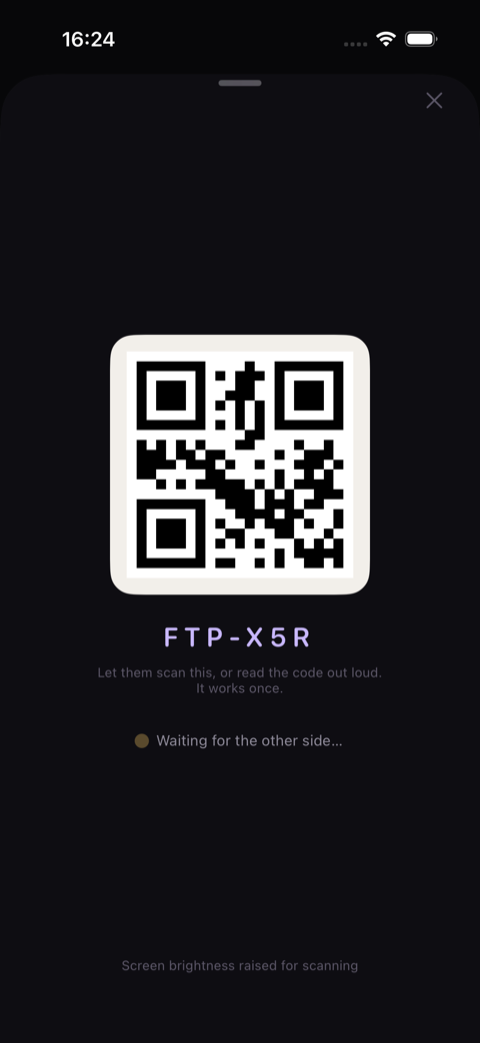
Permanence is the privacy question hiding inside those models. A permanent ID can be kept for years, which is convenient, and it can be phished, subpoenaed, or quietly collected, which is the price. A code that dies with the room leaves nothing behind to collect. We wrote a separate page on why Sotvo chose a room code instead of a phone number, with what each model reveals over time.
Email follows the same logic. Session asks for no address of any kind, and Sotvo and SimpleX Chat drop the sign-up form entirely: nothing to fill in, nothing to verify.
How Sotvo works without a phone number
Sotvo works without a phone number because there is no account for a number to live in. It is a private room for two people who already know each other, and the invitation itself is the identity. Opening a room takes three steps.
- Create a room. Sotvo generates a one-time code that dies with the room.
- Share the code with the one person you want inside, over any channel you trust.
- Talk. When you both leave, the room, the code, and every message in it are gone.
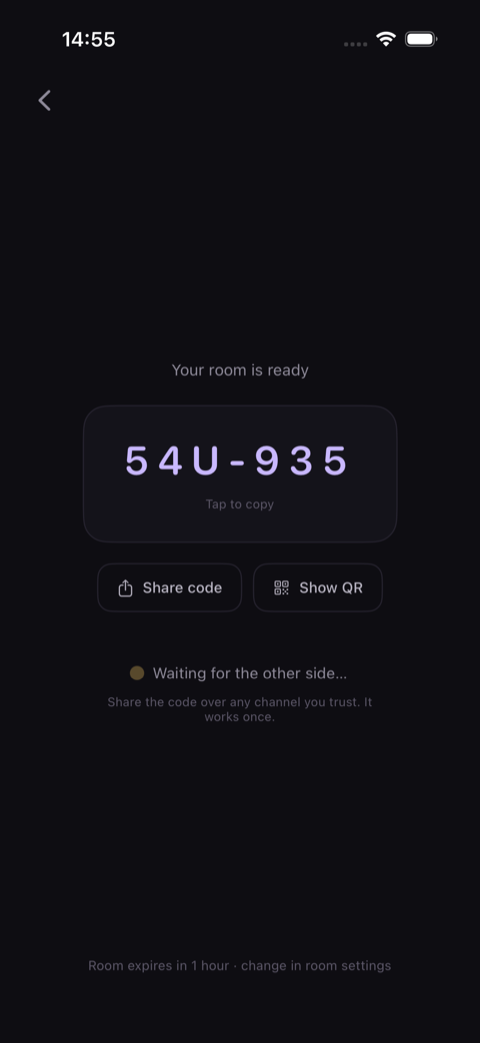
Nothing in that flow is written to disk. Messages live in memory only, each one vanishes within two minutes, and the relay routes what it cannot read: the server never sees the room code or your messages, and IP addresses are never logged, never stored. The security page lists what the server can and cannot see, mechanism by mechanism.
That server-blindness has a name, zero-knowledge encryption: the relay holds the door open without ever holding a key. Sotvo pairs it with end-to-end encryption built on open source cryptography, plus a post-quantum hybrid key exchange on top of the Double Ratchet.
we see that a room exists, never what’s inside.
On a pre-release build in July 2026, the whole exchange took under a minute: one short code read across a kitchen table, and the room was open.
The honest limits: Sotvo is iOS-only, two people per room is the entire product, and there is no multi-device sync, because sync is storage under another name. It is coming soon to the App Store, so the three apps below are the ones you can install today.
Session, SimpleX Chat, and Zangi, compared
Session, SimpleX Chat, and Zangi solve the same problem with three different trade-offs. The table shows what replaces your number in each app, how long that identity lives, and what it runs on. One way to read it: pick by how much identity you want to keep.
| app | what replaces your number | how long the identity lives | platforms | price |
|---|---|---|---|---|
| Sotvo | a one-time room code | one room, then it’s gone | iOS (coming soon) | joining rooms is free; the unlock will be a one-time $6.99 |
| Session | a 66-character Account ID | permanent, restorable with a recovery password | iOS, Android, desktop | free |
| SimpleX Chat | one-time invite links, no user ID | per conversation; your profile stays on your device | iOS, Android, desktop | free |
| Zangi | an app-generated number | permanent while you keep the account | iOS, Android | free for personal use |
Session: a durable identity with no number attached
Session generates a 66-character Account ID on your device and asks for no phone number and no email at any point. The ID is permanent: write down the recovery password and you can restore it on a new phone, which makes Session the closest thing here to a conventional account, minus the personal identity behind it. Messages travel through an onion-routed network of community-run nodes, and group chats are supported. Choose Session if you want one durable, restorable identity and groups alongside your 1:1 conversations.
SimpleX Chat: no user identifiers at all
SimpleX Chat assigns you no identifier, not even a random one; each conversation starts from a one-time link and runs over its own relay queue. The code is open source, and the cryptographic design was reviewed by Trail of Bits in 2022. The cost is friction, since every new contact means generating a fresh link and walking the other person through it. Choose SimpleX Chat if you want the no-identifier model across iOS, Android, and desktop and don’t mind a setup that takes explaining.
Zangi: a number that isn’t your number
Zangi hands you an app-generated number, so your SIM and your carrier stay out of every conversation. It looks and behaves like a mainstream messenger, with voice and video calls, and personal use is free. The code is closed, so its encryption claims rest on trust, without public review. Choose Zangi if you want the smallest change from a familiar messenger and closed source doesn’t bother you.
Which secure chat app works without a phone number?
Session, SimpleX Chat, and Sotvo all encrypt every message end to end by default, so each works as a secure chat app without a phone number. Zangi encrypts traffic as well, but its closed code leaves the claim unreviewed. Skipping the number is itself a security property: a database that never stored your number cannot leak it, and there is no number for a SIM-swap to steal. Session and SimpleX Chat publish their protocols for anyone to audit; Sotvo’s encryption is built on open source cryptography.
a number nobody asked for is a number nobody can leak.
If you’re on Android
On Android, Sotvo will not help you; it is an iPhone app by design. Session and SimpleX Chat are the ones to try: both run well on Android, both skip the phone number, and both are free.
Common questions
What is the app that doesn’t require a phone number?
Session, SimpleX Chat, and Zangi all run without a phone number today. Of the three, Session feels closest to a conventional messenger. Sotvo goes further by keeping no identity at all, and is coming soon to the App Store.
Is there a chat app without a phone number and email?
Yes. Sotvo, Session, and SimpleX Chat ask for neither a phone number nor an email address. Sotvo and SimpleX Chat have no sign-up step of any kind.
Do these apps work on a Wi-Fi-only tablet?
Session and SimpleX Chat do, since neither verifies a SIM: install the tablet or desktop build and the same identity works over Wi-Fi. Sotvo is designed for iPhone.
Is Sotvo free?
Joining rooms is always free. The unlock will be a one-time $6.99 purchase, and there is no subscription.
Can the other person see my real number?
No. None of these apps ever learns your number, so there is nothing to show and nothing to leak, on either side of the conversation.
Does Sotvo ask for my contacts?
No. There is no directory to fill and no address book permission to grant. The room code is the only way in, and the only person who has it is the person you gave it to.