A disappearing messages app is a messenger that deletes each message on its own, after a set time or a single read. Sending one means attaching an expiry to your words: the message arrives, gets read, and removes itself from both phones. Reviewers file the whole category under ephemeral messaging, and we keep a separate guide on what ephemeral messaging means if you want the concept before the apps.
The five best apps with disappearing messages in 2026 are Sotvo, Signal, Session, Confide, and Telegram’s secret chats, ranked here by how little is left behind: on your phone, on a server, and in whatever you handed over at sign-up. Four of them you can install today. One of them is ours.
Sotvo is our app. Here is how we compare it, and where the others are better: every entry ends with a plain “choose it if” line, including the entries that beat us on platform support.
if you came here to turn off disappearing messages on whatsapp or instagram, that switch lives in the app’s own chat settings; this page is for people who want messages to vanish.
The five best disappearing messages apps in 2026
The five apps are listed below, from the one that keeps the least to the one that keeps the most.
1. Sotvo: a private room for two, built to forget
Sotvo is a two-person, invite-based chat room for people who already know each other, and it is coming soon to the App Store. Disappearing sits at the center of the design instead of behind a setting: messages live in memory only, nothing is ever written to disk, and each message clears 2 minutes after it is sent. The room itself is temporary. When both people leave, it stops existing, and there is no account, phone number, or email for it to be tied to. Our server sees that a room exists, never what’s inside.
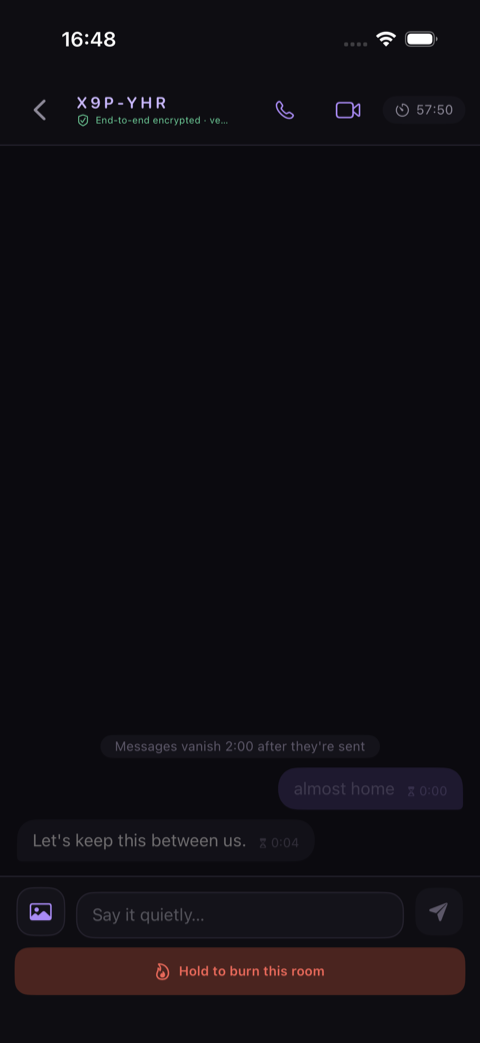
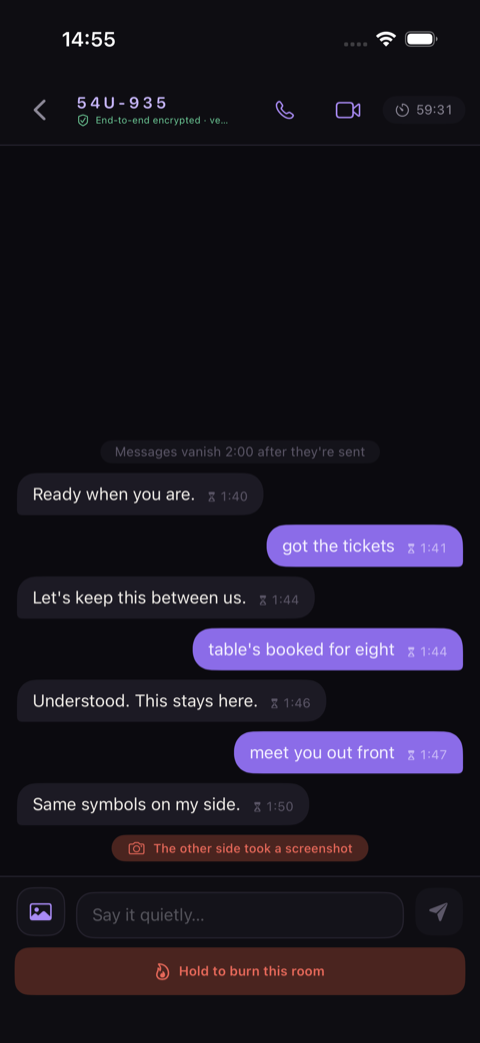
Screenshots can’t be prevented — so they’re never silent: the other person is told every time, without exception. Every room is end-to-end encrypted, with a post-quantum hybrid key exchange layered on the Double Ratchet. On a pre-release build in July 2026, I timed the vanish myself; a message left both screens 2 minutes after I sent it, and the phone’s storage held nothing to recover.
The limits are real, and we would sooner list them than let you find them: Sotvo is iOS-only, a room holds exactly two people, and there is no multi-device sync because there is no account to sync. It grew out of one narrow case, private chat for couples and any two people who want a conversation to leave no record.
Joining rooms is always free. The unlock will be a one-time $6.99 purchase; there is no subscription. Choose Sotvo if you’re on iOS, the conversation is with one person you know, and you want nothing left on either phone.
2. Signal: the best you can install today
Signal is a free, open-source messenger run by the nonprofit Signal Foundation, and its disappearing messages are the most flexible on this list. A timer between 1 second and 4 weeks applies per chat, or as a default for every new chat, and messages delete on schedule for both sides, in one-on-one and group conversations alike. Signal asks for a phone number at sign-up; that number is the one durable thing it keeps that Sotvo never sees. There are no screenshot alerts, though an optional screen-security setting blocks screenshots of the app on Android. Choose Signal if you want disappearing messages on iOS, Android, and desktop today.
3. Session: no phone number required
Session is an open-source messenger that never asks for a phone number; you appear as a Session ID instead of a name and a number. Its disappearing messages run on timers from 5 seconds to 2 weeks, counted from send or from read, and they work across iOS, Android, and desktop. Delivery routes through an onion network, which hides who is talking to whom and adds a little delay. Session removed its screenshot notifications after concluding that detection could be bypassed; that candor matches what we tell our own users about screenshots. Choose Session if handing over a phone number is the dealbreaker.
4. Confide: read-once messages, aimed at work
Confide is an encrypted messenger in which every message self-destructs after a single read. No timer, no saving. Its ScreenShield reading view reveals one line of text at a time, so a screenshot captures a sliver of a message and never the sender’s name beside it. A camera pointed at the screen still defeats that, as it defeats every app on this page. Confide requires an account, and since its 2024 acquisition by Bending Spoons it has leaned toward business use: HR conversations, deal talk, off-the-record office messages. Choose Confide if you want read-once, self-destructing messages at work and don’t mind signing up.
5. Telegram secret chats: a timer you have to turn on
Telegram’s disappearing messages live inside secret chats, a separate mode you start on purpose with one contact on one device. A self-destruct timer runs from 1 second to 1 week, screenshots trigger a notification on iOS, and the conversation exists only on the two phones that opened it. The catch is everything around it: regular Telegram chats sit in Telegram’s cloud, are not end-to-end encrypted, and never expire on their own. Most people never leave that default. Choose Telegram secret chats if you already live in Telegram and occasionally want one conversation to vanish.
How the five apps compare
The table below compares the five apps on platforms, what disappears, timers, screenshot behavior, and price.
| App | Platforms | What disappears | Timer | Screenshots | Price |
|---|---|---|---|---|---|
| Sotvo | iOS (coming soon) | everything; rooms leave nothing on disk | fixed: 2 minutes after sending | always announced to the other person | joining is free; unlock will be a one-time $6.99 |
| Signal | iOS, Android, desktop | any chat with the timer on | 1 second to 4 weeks | no alerts; optional Android screen block | free |
| Session | iOS, Android, desktop | chats with the timer on | 5 seconds to 2 weeks | none; detection was removed | free |
| Confide | iOS, Android | every message, after one read | none; read-once | ScreenShield hides unread lines | free; paid Plus tier |
| Telegram secret chats | iOS, Android (mobile only) | secret chats only; cloud chats remain | 1 second to 1 week | iOS notifies; Android blocks | free |
What about WhatsApp disappearing messages and Instagram vanish mode?
WhatsApp and Instagram build disappearing features into apps you already have, and for casual use they work. WhatsApp’s disappearing messages delete after 24 hours, 7 days, or 90 days; vanish mode on Instagram clears a chat once it has been seen and closed. Two things separate a built-in feature from a dedicated app. First, the default: on both platforms the normal mode is permanent, and one mistap sends a message that never expires. Second, what remains with the company: your account, your contacts, and the metadata around every message stay on Meta’s servers after the bubbles are gone.
The screenshot rules split the two platforms: Instagram notifies vanish-mode screenshots, WhatsApp says nothing. We keep a separate page on what happens when someone screenshots in each of these apps, and in ours.
deletion reaches the app. it never reaches a camera pointed at the screen.
If you’re on Android
Sotvo won’t help you here; it is an iOS app, and pretending otherwise would waste your evening. Install Signal for the widest coverage and the most flexible timers, or Session if you want to skip the phone number. Both are free, and both handle disappearing messages well enough that nothing on this page should pull an Android user anywhere else.
Frequently asked questions
What is the best app for disappearing messages?
For most people today, the best app for disappearing messages is Signal: it runs on iOS, Android, and desktop, and its timers span 1 second to 4 weeks. On the narrower measure this page ranks by, how little is left behind, Sotvo leads, and it is coming soon to the App Store.
Do disappearing messages really disappear?
Yes, inside the app. Deletion removes the message from both phones and, in the better apps, from servers. No app can recall a screenshot, a photo of the screen, or a copy made before the timer ran out, which is why notification matters more than prevention.
Are self-destructing messages different from disappearing messages?
No. Self-destructing messages are disappearing messages with a per-message trigger, usually a single read, while a disappearing-message timer usually covers the whole chat. Confide is the cleanest read-once example, Signal and Telegram use timers, and Sotvo fixes the clock at 2 minutes after sending inside a room that ends when you leave.